- Home
- The Federation of Emscote Infant School and All Saints’ C of E Junior School
- Schools
- Emscote Infant School
- Curriculum
- Early Years
Early Years
Curriculum statement - EYFS Vision
Every child is unique and we strive for them to be the best that they can be.
Aims:
Our main aim is to enable every child to achieve his or her potential. To do this, we need to create a peaceful environment in which tolerance, mutual cooperation and stability are encouraged, so that each child can work productively, learn to make decisions, use his or her own judgement and co-operate courteously with others. As a school, we are trying to achieve these high standards by responding professionally, sensitively and caringly to the needs of all our pupils.
The Curriculum:
The Reception classes follow the curriculum as outlined in the Early Years Foundation Stage (EYFS) Framework, which is available to download at https://assets.publishing.service.gov.uk/media/68c024cb8c6d992f23edd79c/Early_years_foundation_stage_statutory_framework_-_for_group_and_school-based_providers.pdf.pdf This clearly defines what we teach.
The EYFS framework includes seven areas of learning and development, all of which are seen as important and interconnected. Three areas are seen as particularly important for igniting children’s curiosity and enthusiasm for learning, for building their capacity to learn and form relationships and thrive (DfE 2014: 1.3). This supports children’s learning in all other areas and they are known as the Prime Areas.
The Prime Areas are:
- Communication and Language – Listening, Attention, Understanding and Speaking
- Personal, Social and Emotional Development – Self Regulation, Managing Self and Building Relationships
- Physical Development – Gross Motor Skills and Fine Motor Skills
The Specific Areas are:
- Literacy – Comprehension, Word Reading and Writing
- Mathematics – Numbers and Numerical Patterns
- Understanding the World – Past and Present, People Culture and Communities and The Natural World
- Expressive Arts and Design – Creating with Materials Being Imaginative and Expressive
The Specific Areas of Learning develop essential skills and knowledge for children to participate successfully in society.
Key features of our EYFS curriculum:
- In Reception, we nurture our children so they feel safe at school to learn, make friends, make mistakes and to grow. We help our children to understand and regulate their emotions so we have happy children, who are ready to explore and learn.
- In Reception, we allow our children to develop their independence and problem-solving skills as well as being able to seek support when needed.
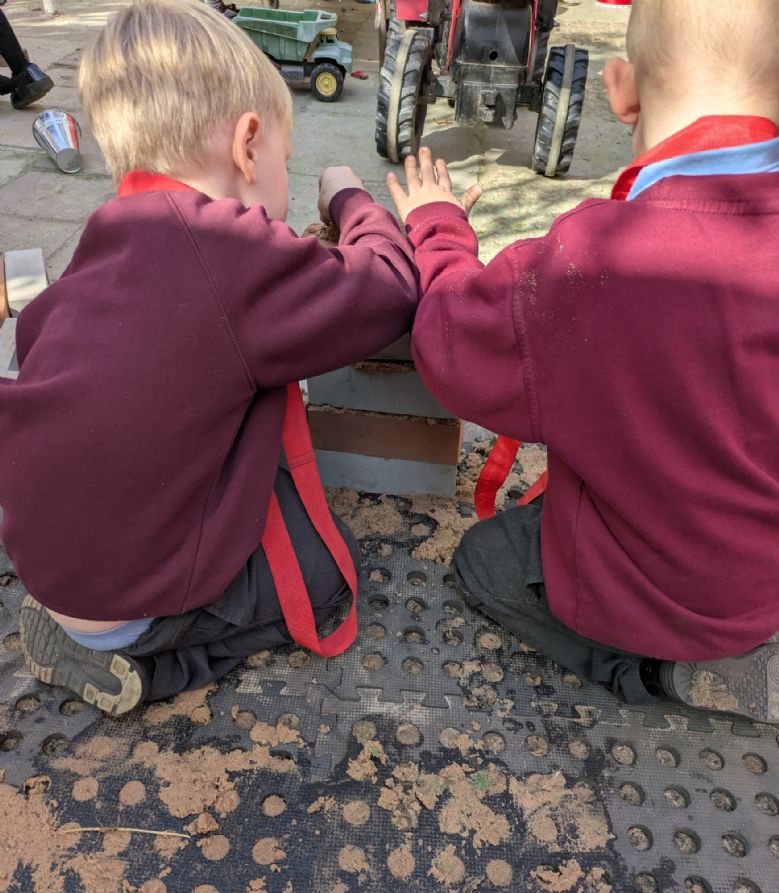
- In Reception, we deliver the EYFS Framework through play-based learning. We believe children learn best from activities and experiences that interest and inspire them. By following children’s interests, we provide them with stimulating, active play experiences in which they can explore and develop their learning to help them make sense of the world.
- In Reception, we play and interact with our children to develop relationships with them, develop their imagination and their self-confidence.
- In Reception, we teach some direct, carefully planned, adult-led experiences for our children in the form of structured teaching and adult-led group activities (Maths following the Mastering Number programme and Phonics following the Little Wandle Phonics scheme). These are particularly important in helping children to learn specific skills and knowledge.
- Although not the focus of our time (as we prefer to be spending time with our children) in Reception we record our children’s learning in a variety of ways. We use Seesaw as our online platform; we have Learning Journeys for the children (which show the holistic child) and we have our class Maths floor book. There are opportunities to look at the children's books during our termly 'Book Looks.'
- In Reception, reading and stories play an important part of the day. We want to make sure our children have a love of books and leave the EYFS with a bank of stories they know well, both traditional and modern classics.
- In Reception, we spend quality time with our children so we really get to know them as individuals. We explore and follow their individual interests so they are motivated and ready to learn.
- In Reception, we create endless learning opportunities to excite our children about the world around them. They have access to their learning environment every day and we enhance it throughout the year based on their interests.