- Home
- The Federation of Emscote Infant School and All Saints’ C of E Junior School
- Schools
- All Saints’ C of E Junior School
- Curriculum
- Maths
Maths
Curriculum statement - Mathematics Vision
Intent
‘Every child is a mathematician’
Our aim at All Saints’ is for all children to enjoy mathematics. We want to help them develop a secure and deep understanding of fundamental mathematical concepts and procedures so that when they leave us to transition to secondary school they are well prepared for the next step in their learning. We want children to see the mathematics that surrounds them every day and enjoy developing vital life skills in this subject.
Our aim is for all children to think mathematically, enabling them to reason and solve problems in a range of contexts across all areas of the curriculum.
At All Saints’, our Mathematics Mastery curriculum is being developed to ensure every child can achieve excellence in mathematics. Children can experience a sense of awe and wonder as they solve a problem for the first time, discover different solutions and make links between different concepts
Providing pupils with a deep understanding of the concept through a concrete, pictorial and abstract approach helps ensure pupils fully understand what they are learning.
Key features of our Maths Mastery curriculum:
- High expectations for every child
- Fewer topics, greater depth
- The answer is just the beginning – focus on mathematical thinking, language and reasoning
- Concrete, pictorial and abstract resources that are progressive to support learning
- Calculate with confidence – understand why it works and make links.
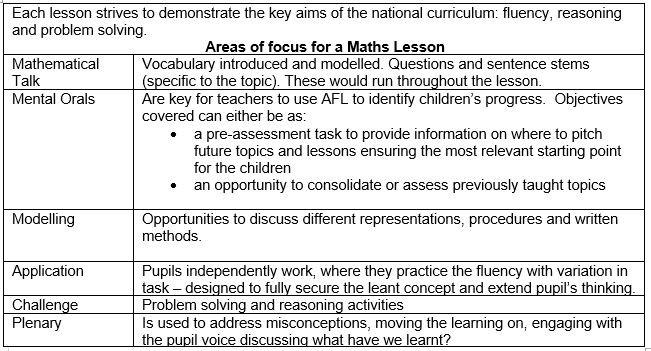
The National Curriculum is delivered through the use of Rising Stars, which is based on a Mastery scheme of work. Rising Stars identify the objectives for each topic block which are derived directly from National Curriculum. The objectives in each block are broken down in to a series of carefully planned small steps.
Staff development
Our implementation is developed through secure understanding of the curriculum and subject area. Previous DfE funding enabled us to engage and embed a whole school approach with intensive staff training. The maths team continue to provide a bespoke training programme to develop high quality practice following monitoring activities.
- These include in house service training (INSET) delivered by the Maths leads and Maths Hub Accredited Schools.
- Coaching and mentoring (formal and informal support)
- Training courses where appropriate
- Observing outstanding practice in schools through links with our local Maths Hub
- The Rising Stars scheme allows teachers to update their own professional development with a series of CPD videos around a range of maths topics
- The school has also invested in the National College which allows teachers to update their own CPD or watch training directed by the SLT
The maths lead receives regular CPD opportunities through the Gateway alliance and our active Consortium training. This is then disseminated to staff through Inset opportunities.
Resources
Planning is supported by the use of Rising Stars. Teachers are also able to use White Rose, National Centre of Excellence in the Teaching of Mathematics (NCETM), NRICH and a range of resources provided by the Maths leads.
The Mastery Approach incorporates the use of Concrete, Pictorial and Abstract methods (CPA approach). This helps children explore and demonstrate mathematical ideas, enriching their learning experience and deepening their understanding.
Teachers adapt the lessons to fit to the objectives they have planned using resources throughout the school.
Role of the Subject Leader:
- Ensures teachers understand the requirements of the National Curriculum and supports them to plan lessons.
- Leads by example by setting high standards in their own teaching.
- Leads the whole-school monitoring and evaluation of teaching and learning in mathematics by observing teaching and learning in mathematics regularly; analysing assessment data in order to plan whole school improvement in mathematics; conducting work scrutiny to inform evaluation of progress; conducting pupil interviews.
- Takes responsibility for managing own professional development by participating in external training, engaging in educational research and keeping up-to-date with Teaching for Mastery developments.
- Keeps parents informed about mathematics issues.
- Ensures that the school’s senior leaders and governors are kept informed about the quality of teaching and learning in mathematics.
- Works in close partnership with the school’s senior leaders to ensure the learning needs of all pupils in mathematics are met effectively.
- Keeps the school’s policy for mathematics under regular review.
Assessment
- Formative assessment is embedded in every lesson using a variety of strategies including observation, questioning, outcomes and challenge. Teachers and TA’s use these to inform future planning and identify gaps in learning.
- Summative assessment takes place at the end of each term or sometimes after a topic of work to monitor and track progress of pupils alongside teacher assessment. Teachers record this on an online assessment system which senior leaders can access in order to track progress from individual children to the whole school.
Monitoring
The maths curriculum is monitored through a range of methods, which includes:
- Book and planning scrutiny
- Learning walks
- Pupil voice
- Pupil progress meetings where identified groups of pupils are targeted
Moderation
Moderation takes place in school and also in locally arranged events with other schools within our consortium.
Work-life balance
Teaching staff only have to produce purposeful resources that will impact on the teaching and learning in the classroom and they are signposted to resources to supplement their lessons.
Using a scheme allows our staff to adapt to the needs of the children enabling them more time to produce valuable resources and reducing workload. It contains opportunities for Talk for Maths and has CPD videos to support staff development and confidence.
Our marking policy has been adapted to help staff reduce their workload but still provide relevant and targeted feedback to those children who need it.