
- Home
- The Federation of Emscote Infant School and All Saints’ C of E Junior School
- Schools
- Emscote Infant School
- Curriculum
- Protective Behaviours
Protective Behaviours
Protective Behaviours
Protective Behaviours is a practical approach that helps children learn about personal safety, confidence and wellbeing. It supports children to understand their feelings, build self-esteem and develop the skills they need to help keep themselves safe.
Through this approach, children learn to recognise their feelings and understand that these feelings can help them know when something does not feel right. They are also encouraged to develop strategies for keeping themselves safe and to know who they can talk to if they are worried.
Protective Behaviours promotes a positive and confident outlook, encouraging children to enjoy new experiences, have fun and explore the world around them in a safe and supportive way.
Protective Behaviours is widely used in education and supports many areas of learning, including personal development, wellbeing, relationships and health education.
The programme is based on two simple but important messages:
-
We all have the right to feel safe all the time.
-
We can talk to someone about anything, even if it feels small or difficult.
How does it work at school?
During the Autumn term, children will take part in a series of age-appropriate lessons that introduce the ideas of Protective Behaviours.
These messages will continue to be reinforced throughout the year and are closely linked to our PSHE (Personal, Social and Health Education) curriculum. Through stories, discussions and activities, children learn about feelings, trusted adults and ways to keep themselves safe.
Here are some useful links for parents and carers to look at from home.
https://www.protectivebehaviourstraining.co.uk/publications/lets-talk-magazine
Rights Respecting School Links: Article 16 – Right to Privacy; Article 19 – Protection from Violence, Abuse and Neglect

The Network Hand
The Network Hand is a simple activity that helps children think about the trusted adults they can talk to if they need help or support. It encourages children to identify people in their lives who listen to them and help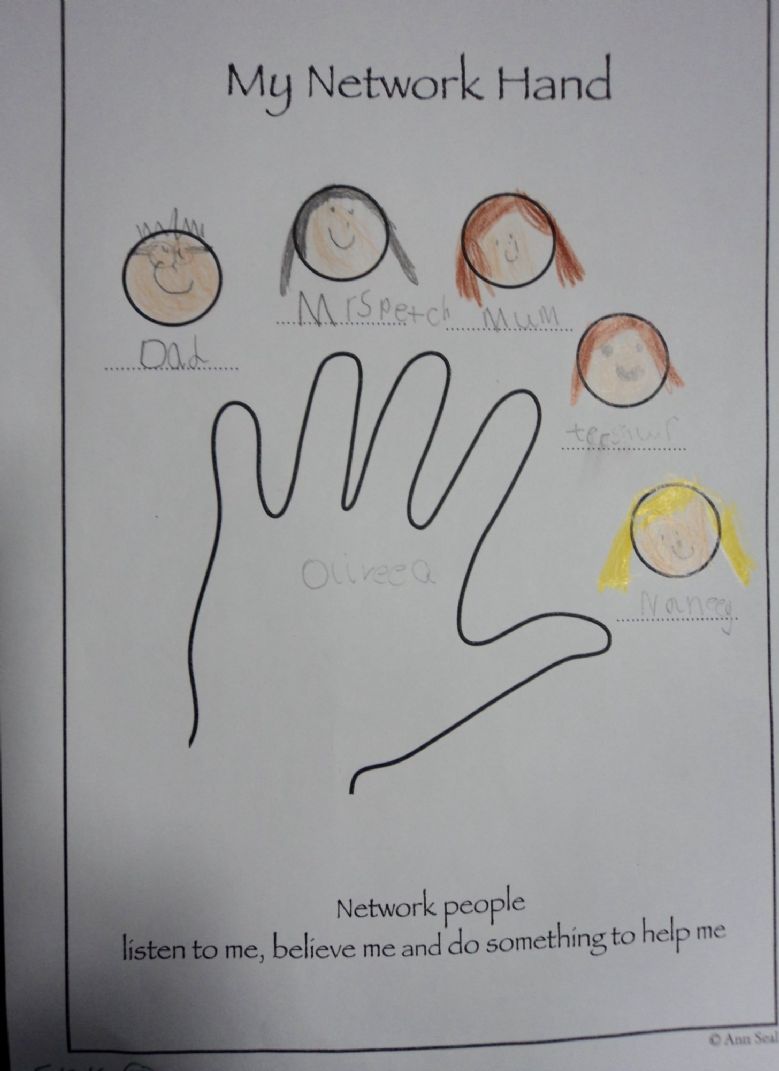 them feel safe.
Children are asked to think of their “network people” – adults they trust such as parents or carers, family members, teachers or other safe adults. These are people they know they can speak to if they are worried, upset, or need help with something.
The activity links to the two key messages of Protective Behaviours:
-
We all have the right to feel safe all the time.
-
We can talk to someone about anything, even if it feels small or difficult.
Children usually begin by drawing around their own hand and writing the name of a trusted adult on each finger. A template can also be used if needed. The aim is to help children identify a range of trusted adults, not only family members, so that they have someone they can talk to in different places and situations, such as at home, at school or in the community.
The Network Hand can be a helpful safeguarding tool and also provides a great opportunity to start conversations about the important people in a child’s life and how they can support their wellbeing. At school, we regularly revisit this activity to support children to know who their trusted adults are and how these may change at holiday times.